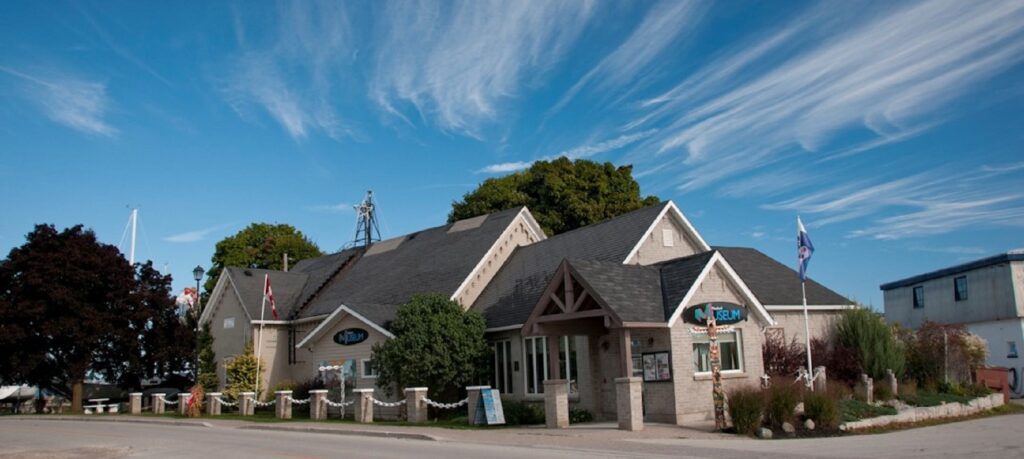
History of the Municipality
The story of the Municipality of Meaford area began on October 2, 1833, when land surveyor Charles Rankin established a survey base camp along the shores of Georgian Bay, temporarily naming the area “Zero Township.” Less than a year later, on April 28, 1834, the area was officially renamed the Township of St. Vincent. In 1835, Rankin reserved 200 acres at the mouth of the Bighead River as a town plot within St. Vincent Township. This settlement would eventually become the community we know today as Meaford. Development was gradual, and it was not until 1840 that David Miller built the first cabin on one of the reserved town lots, helping establish the future village.
Meanwhile, neighbouring Sydenham Township was surveyed in 1842, with concessions laid out from north to south. At that time, the landscape consisted primarily of dense hardwood forest that would gradually be cleared and developed by incoming settlers.
As word spread about the opportunities available in the region, both townships grew steadily, attracting settlers from across Canada and around the world. Farms, businesses, schools, churches, and community organizations soon took root, creating the foundation for thriving rural communities.
A significant chapter in the area’s history began in 1942 with the establishment of the Meaford Military Camp, now known as the 4th Canadian Division Training Centre. Built on approximately 20,000 acres of land along Georgian Bay in St. Vincent Township, the facility was developed to provide tank warfare and artillery gunnery training during the Second World War. Commonly referred to as Camp Meaford or “The Tank Range,” the training centre remains in operation today and continues to host military personnel from across Canada and around the world.
More than a century after the area’s first settlement, municipal restructuring in Ontario brought significant change. In 2001, the Town of Meaford, St. Vincent Township, and Sydenham Township were amalgamated to form the single municipality known today as the Municipality of Meaford.
The history of these communities reflects the vision, determination, and hard work of the surveyors, settlers, soldiers, and community leaders whose efforts helped shape the Meaford region into the vibrant community it is today.
Hisory of The Museum Building
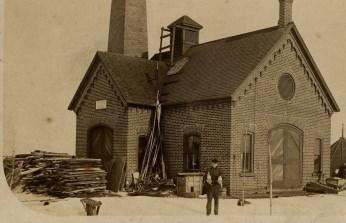
1895
The Meaford Museum has a working past; it began its life as the town’s Pumping Station, originally built by McQuillen and Co. A few years later, a brick chimney was added in an effort to make the station run more efficiently.
1924
Welcome to the ‘Power House’ (as the locals came to call it). An electric pump and auxiliary gas pump were installed, and when the Public Utilities Departments relocated here, the building earned its name.
1940’s
The brick chimney was taken down and both the Public Utilities and Public Works departments vacated the building, leaving it unoccupied and waiting for its next chapter.
1961
Since the Meaford Museum officially opened its doors, it has welcomed guests from across the globe, drawn to discover some of its unique and one-of-a-kind artifacts.
The building’s path from Power House to prized landmark owes much to the Kent Women’s Institute, who led the building’s transformation into a museum. Donations from the Sing and Godfrey families formed its first collections.
1997
As the collections grew and number of visitors increased, a series of renovations expanded room sizes and display space, improved the lighting, and modernized the building itself.
Modifications included a front addition to accommodate the museum’s foyer and general store, generously donated by The Apple Harvest Craft Show, The Kiwanis Club, Lions Club and Kinsmen Club.
1998
An addition was added to house the temporary collection of the 1938 Bickle Maple Leaf Fire truck, donated by the Meaford Fire Department. This addition was funded by the local Kiwanis Club and built by local residents and contractors.
2020 +
Today, the Meaford Museum showcases an array of artifacts and collections related to our local community and nation’s history.
The most recent renovation was the Farm Shed, located on the museum’s northern grounds. Made possible by the late Joe Walker’s estate, the Shed is home to a collection of large farming tools.
There are four rooms for visitors to explore and discover a history that no longer ends at Meaford’s borders. The museum also serves the Townships of St. Vincent and Sydenham, creating a large and diverse region from which to draw stories and artifacts.
We are pleased to welcome you to the Meaford Museum and are excited that you’re here to share our history in the making.