Growing our economy, ensuring sustainability, strengthening our community, and investing in infrastructure are among Council’s strategic priorities.
To meet our community’s needs and deliver on these priorities, the Municipality is committed to handling and investing the public’s tax dollars wisely.
How do we do this? This is all laid out in the Municipality’s annual budget, a collaborative effort and process in which community feedback is invited and highly valued.
Find out where your money goes, including how and where funds are allocated, and how the budget accounts for future challenges.
Approved 2026 Fees and Charges
On February 6, 2026, the 2026 Mayor’s Budget was deemed adopted.
Learn About the Budget
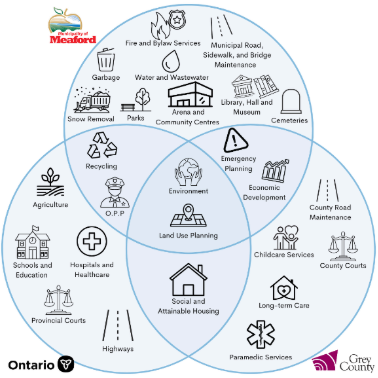
Municipal
Local roads, water and wastewater, garbage and recycling, parks and recreation, fire services, libraries, and local by-law enforcement.
County
Social services, paramedic services, long-term care, county roads, and planning approvals.
Provincial
Healthcare, education, highways, policing (OPP), social assistance programs.
Property Taxes and Assessment
Residents in all municipalities are required to pay municipal property taxes. The funds collected are used to ensure the Municipality can provide services, including road maintenance, garbage and recycling services, parks and fire services and more. For more information on property taxes, visit the property taxes page. For more information on assessed home value, visit MPAC: www.mpac.ca/en
FAQ
The Municipality’s Operating Budget is the source of funding for all day-to-day programs and services provided by the Municipality of Meaford. It includes services such as:
- Protective services (Fire and O.P.P)
- Library and recreation programs
- Park maintenance
- Snow removal and more.
In 2024, the total operating expenses were $29,069,670 but the total tax levy required (amount from taxpayers) was $13,731,230.
Capital projects like road repaving are prioritized using the Municipality’s Asset Management Plan (AMP) and State of Infrastructure (SOTI) report. These assess road conditions, prioritize repairs, and estimate costs. Updated traffic data helps ensure decisions meet maintenance standards. Projects are prioritized based on these assessments and available budget.
The budget consists of all the expected costs for the Municipality to provide a wide range of services to residents. To help pay for these costs, the Municipality issues property tax bills to residents for their share of these costs based on the assessment of their property. Together with the province and county budget changes, the Municipality calculates the total percentage increase for all three and applies that increase to property owners taxes for the year.
Strong Mayor Powers gives the Mayor the responsibility to propose the municipal budget, subject to Council’s ability to propose amendments. This replaces the historical Councill budget process. Once the Mayor submits the budget, Council has 30 days to propose changes and the Mayor then has 10 days to approve or veto those changes, following the rules set out in provincial legislation.
Water and wastewater costs are paid by the users of these services unlike the rest of the budget which is paid for by all property owners of the Municipality. Any funds budgeted for water and wastewater services can only be used for these services and unspent funds are put into reserves for future water and wastewater costs. Wherever possible, the Municipality uses grants and other revenue sources such as development charges to help offset these costs.
Residents are encouraged to attend public budget meetings. The public budget meetings for the 2026 budget are January 12, 15 and 16.
The core services of the budget have outlined the cost to keep service levels consistent with current levels, at the cost to deliver it in 2025. Elective services will enhance services and quality of life for residents, if selected by Council.
Back in September 2024, Council passed to adopt a new Development Charge Background Study. Through this study the Municipality has determined what projects need to be done over the next 10 years to handle any growth and development anticipated. The cost of these projects is then budgeted to be paid for by Development Charges which is paid by developers. This means that growth pays for growth and minimizes the impact to existing taxpayers.
Municipalities often face higher costs for services and infrastructure due to inflation, including rising prices for materials, labor, and utilities. To maintain essential services, municipalities may need to increase taxes to cover these increased expenditures.
Inflation impacts various services, including public safety (police and fire), road maintenance, waste collection, and community services. Rising costs can strain budgets, necessitating adjustments in funding through tax increases.
Tax increases are typically determined through a budget process that assesses current financial needs, projected inflation rates, and community priorities. Public surveys and Council meetings help shape these decisions.
Municipalities may explore prioritizing core services, cost-cutting measures of elective services, seeking alternative funding sources, and implementing efficiency improvements to manage budgets.
Residents can participate in public meetings, submit feedback during budget consultations, and engage with local elective officials and CAO to voice their concerns and seek clarification on budget decisions.
Continued inflation can strain municipal finances, leading to difficult choices about service levels and the provision of elective services. Balancing budgetary constraints with core services is crucial for long-term financial sustainability.
While tax increases are often necessary to improve services, when inflation has not been previously applied, a tax hike only maintains the service quality. In times of inflation, Municipalities aim to allocate funds effectively to address core services.
Municipalities typically review tax rates annually during the budgeting process, considering factors such as inflation, service levels, and overall economic conditions.
Municipalities may consider alternatives such as grant funding, public-private partnerships, and cost-sharing initiatives to alleviate the need for significant tax increases while still providing core services.
Resources
The 2024 Budget was adopted on February 26, 2024.
Municipal staff, at the direction of Council, provided a budget with a total tax increase of 3.44%, including the County and Education portions. The average Meaford homeowner with a property assessment of $300,000, will see an increase of about $12.50/month or $150 yearly.
Paper copies of the budget can be available upon request.
Final 2024 Capital and Operating Budget Book
2024 Fees & Charges
2022 Financial Statements
Consultant Reports
- BMA Management Consulting Inc. Municipal Study 2024
- BMA Management Consulting Inc. Municipal Study 2023
For other historic Financial Statements, please contact the finance department.
Budgets
21 Trowbridge Street West, Meaford, Ontario, Canada, N4L 1A1